
A friend sent me this and I just can’t resist — I am hoping we in our situation will find it even funnier….
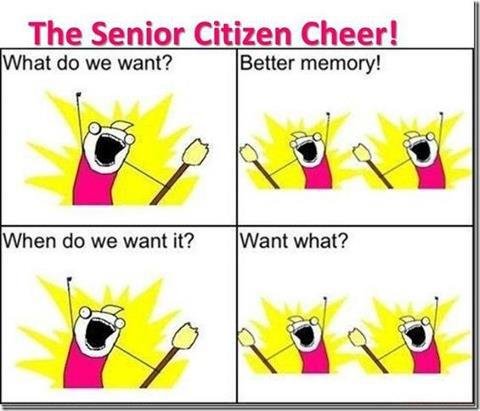
A friend sent me this and I just can’t resist — I am hoping we in our situation will find it even funnier….
Comments Off on The Senior Citizen Cheer
Filed under Uncategorized
Well I’ve been spending a lot of time with Dr. Google lately, digging into the drug trials and drug assessments. Seems like the most thorough ones are the ones where government bodies in countries with public health are trying to figure out if the enormous cost of these drugs is worth the money in terms of patient and carer quality of life. (I’m paraphrasing an awful lot of statistics and probabilities and assorted test scales here, most of which I don’t understand very well.)
However, the bottom line (and they mean it!) seems to be that the drugs like donepezil (Aricept) work in terms of improving life for patient and caregiver, at least until the severe stage, but that the deterioration continues underneath the drug treatment of symptoms, so that stopping the drug leads to almost immediate huge setbacks.
Memantine (Trade name Ebixa here in Canada) works to improve mood and maybe function a little tiny bit, (in several studies not even statistically significant) and is considered cost effective. However, the delay to care home placement is measured in weeks or a couple of months. And here I thought we were talking years of stabilization! No miracles here, folks (move along).
Nonetheless these incredibly expensive — and profitable — drugs are cost effective for government systems because even a few months of delay in placement saves thousands of dollars to the health care system.
I THINK, if I read it right, the assessment for the UK also indicated that although these drugs do help somewhat with functionality, they do not affect life expectancy — they slow down the deterioration but do not stop the progression of the disease, which is going on underneath the drug treatment. Most of the trials continue to be of such short term though – 6 months, 24 months – that there really isn’t a lot of info. Also the government assessment is most concerned with delay of placement in care homes, not long term outcome.
Very confusing and of great interest to those of us like me who wonder how long WE can survive our loved ones’ illness.
http://www.nice.org.uk/nicemedia/live/13419/53619/53619.pdf
db
Filed under Uncategorized
Another Mayo Clinic Alzheimer’s blog this morning and I found myself lingering over two earlier posts, both of which are enormously helpful to caregivers’ relations.
They deal with the different kinds of memory what is affected how.
One was on procedural memory (brushing teeth, finding “your” chair) which remains intact for a very long time.
http://www.mayoclinic.com/health/memory-and-dementia/MY02533
The other was on emotional memory and how emotions linger long after the cause is forgotten and thus “blow ups” are triggered.
http://www.mayoclinic.com/health/emotional-memory/MY02540
I figure that’s why it is so important to paste a smile on your face and be calm and non-argumentative, no matter what you really think – the not-so-“patient” has no recall of what events ACTUALLY triggered their emotions.
I just realised that has become my new morning discipline — some of us meditate, I practise smiling.
db
Comments Off on Different Kinds of Memory
Filed under Uncategorized
This is a pretty amazing demonstration of the ability to communicate long after the words have gone….music and early memories remain to be used as a bridge. The video says to check out memorybridge.com for more information, and I sure will. I am pretty sure that such techniques modified to each person’s level of disability (not so extreme) will also work with our dear ones who are not so far lost in this path. I guess we will find out 🙂
A day to be thankful for what we have, because it always could be so much worse, and because we have friends like our Tuesday group to help us along this long and lonely way.
db
Filed under Uncategorized
Here’s what that workshop said worked liked like magic (there was more but I had to go pay attention to the hurricane brewing in my living room…you know!)
On Criticism
Don’t deny, don’t defend, don’t counter attack, and don’t withdraw.
Maybe it’s a mantra for those in horrid spaces with their beloved.
Hard to do – requires being absolutely centred – not self-centred – just centred, – breathing from the diaphragm and knowing all is dust and ashes and joy and tears of laughter ….
I think this has something to do with it all (although I couldn’t say exactly precisely what!) … but all the wisdom ties together https://careingcv.wordpress.com/2013/10/09/looking-forward-to-more-self-care/#comment-14
db
Filed under Uncategorized
Does anyone know what the effects of memantine are — they tell me it will (or MIGHT) stabilize my love at his current level of ability (which is better than him getting worse naturally) but I am wondering how it affects the overall course of the disease. (as if we know what that is!) What I am wondering (and I suppose it is wicked) is whether this drug means he will be “stabilised” like this for another decade? Or if the typical disease profile still applies?
Comments Off on Memantine
Filed under Uncategorized
As this long journey goes on (and on and on and on) I find myself being forced to spend more time thinking about me and how I am doing. Not so well, some days, for sure. I can feel that I am developing the same “pain in the neck” that I had for two years before my mother died, and now I am facing a long drawn-out similar situation with my love. Yikes. I need to learn how to put the joy back in my days, because I could die with this situation still continuing. Can’t “wait it out” because it could be another decade or even two. Unreal. I have to learn to be joyous in the midst of this, and I need to stop thinking of it as a prison (although it is — one with no hope of parole!)
All this whinging started out as a simple note to my Tuesday group friends about the next tele workshop I hope to listen to: ” Strengthening Your Caregiver Backbone: Assertiveness Skills for Family Caregivers: In this session you will learn some simple yet effective communication tools that will benefit any interactions you have with others. Learn how to be more assertive with the person for whom you are caring, other family members and people in the healthcare system. Assertiveness involves actively expressing yourself, while also listening to and respecting the rights of others. Whenever there are differences, both minor and major, becoming assertive can help to minimize the ongoing confrontations that can rapidly develop due to the stress and demands of caregiving. This webinar is facilitated by Allison Reeves, Registered Clinical Counsellor and runs from 6:30 – 8:00 PM. We gratefully acknowledge the United Way of Greater Victoria and the Province of British Columbia for partial funding of this event.”
You can register through http://www.careringvoice.com/for-caregivers.php
db
Filed under Uncategorized
Here’s a course at NIC that might be of use to some of us — I am planning to take it if I can get a caregiver for the day!
GENI-5750
http://www.nic.bc.ca/continuingeducation/searchforcourses.aspx?type=ALL&campus=ALL&search=DEMENTIA
Filed under Uncategorized
Just got an email from the Care-ring Voice Network about their fall webinars — or tele-workshops. The workshops are also listed here: http://www.careringvoice.com/tele-upcoming-sessions-home.php
These are free sessions that you phone in to, and sometimes you can ALSO watch on your computer (but the phone is the important part). They are usually in the evening or at noon, and only one or two hours. There are several sessions this fall on elder abuse, but also lots on and for Caregivers too.
The BC Family Caregivers Network Society (http://www.careringvoice.com/tele-upcoming-sessions.php?id_organization=27) has one on Assertiveness Training for Caregivers. Hope it tells me how to tell my guy NO without triggering a major episode. Or maybe how to tell people they really have no idea what is going on in his head (or not) when he smiles and looks pleasant.
Many of the BC workshops are facilitated by Allison reeves, a therapist in Victoria who I find enormously helpful. Don’t know how she gets the emotional energy to be so empathetic and directed at the same time, but she has helped me many times over these many years.
Anyway, I hope people take advantage of these workshops — they are a wonderful resource, and one more way of sharing our burdens, our successful strategies, and our joys.
-DB
Filed under Uncategorized
Ok folks – I’ve actually got it to work — the way it goes is….I add you – you get an email inviting you to set up a wordpress account. Do that (just an email and a password) and then log out. Ignore other emails from WordPress unless you do want to start your own blog. Your next email from caring CV will be an invite to be an author — click accept and you will be able to make you own new posts.
Comments Off on Inviting new authors
Filed under Uncategorized
 CaringCV